
Should I repair or replace my AC unit is one of the most common questions homeowners ask when their air conditioner starts acting up. If your AC is struggling to keep your home cool, making strange noises, or causing energy bills to climb, it can be difficult to know which option makes the most financial sense.
Here’s what matters: if the repair is minor and your system is relatively young, repairing it is often the better choice. If your unit is older, requires frequent repairs, or struggles to cool your home efficiently, replacement may save you more money over time. At Air Mavericks, we help Largo homeowners evaluate both options honestly so they can make informed decisions without unnecessary expenses.
Air conditioning units work harder in Florida’s heat and humidity. Your AC in Largo goes to work when most systems across much of the rest of the nation aren’t really doing anything for long periods of time. This means that even more consideration must go into whether to repair or replace your equipment based on age, efficiency and repair history.
Key Takeaways
- AC units under 10 years old are often worth repairing.
- Frequent breakdowns usually indicate replacement may be more cost-effective.
- Rising energy bills can signal declining system efficiency.
- Major component failures often justify considering a new system.
- Professional inspections provide the most accurate recommendation.
Start With the Age of Your AC Unit
One of the major elements in choosing to repair or replace is the age.
With proper maintenance, almost all residential air conditioning systems will last back to 10 – 15 years. Of course, some systems may have a longer lifespan, but efficiency tends to fall off as equipment ages.
Consider Repairing If:
- Your AC is under 10 years old
- Repairs have been infrequent
- Cooling performance remains strong
- Energy bills have remained stable
Consider Replacing If:
- Your air conditioner is over 12 to 15 years old
- Repairs are becoming more frequent
- Parts are difficult to source
- Energy costs continue increasing
Now, hear me out: it usually doesn’t make sense for you to spend thousands of dollars on a system that is already at the end of its lifetime.
The Cost of Repairs Matters
Not all repairs should be a replacement, either.
Most of the time, a bad capacitor, thermostat problem, clogged drain line or small electrical repair can all be resolved at a low cost. But a catastrophic failure of the main components can upset this balance.
Common expensive repairs include:
- Compressor replacement
- Evaporator coil replacement
- Condenser coil replacement
- Refrigerant leaks requiring extensive repairs
- Major electrical failures
One common guideline that is widely followed by many HVAC companies is known as the “the 50% rule”. If the unit is older and if a repair costs about 50 percent of new-system value, replacement could provide a better long-term solution.
At Air Mavericks, we often help homeowners compare repair costs against the expected remaining lifespan of the existing system before making a recommendation.
Watch for Frequent Breakdowns
Getting one repair done every few years isn’t unusual.
That however is another story altogether which I would not be comfortable having to make 3 repairs every single cooling season.
Your AC was just repaired, and another problem re-emerges shortly after.
Warning signs include:
- Several service calls in less than a year
- Another failure of a component one after the other
- Increasing repair costs
- Longer cooling cycles
- Reduced indoor comfort
What you need to do is: write down every repair done. Once cumulative costs are heading into replacement territory, that is when you really should consider a new system.
Rising Energy Bills Can Signal Bigger Problems
Many homeowners focus only on repair costs and forget to consider energy efficiency.
That translates to old systems using more power than contemporary equipment. A drop in efficiency can cost you more in monthly utility bills, even if your AC continues to function properly.
Your system appears to be losing efficiency if any of these:
- Higher electric bills
- Longer run times
- Difficulty maintaining temperature
- Uneven cooling throughout the house
Considering the fact that air-conditioning systems run for much of the year in Florida, modern high-efficiency systems can cut those cooling costs dramatically.
This can offer savings which may help cover the installation costs over time.
Consider Refrigerant Type
Older air conditioners often use R-22 refrigerant.
Since R-22 production has been phased out, repairing systems that require this refrigerant can become increasingly expensive.
If your unit uses R-22 and develops a significant refrigerant leak, replacement is often the more practical option.
New systems use environmentally friendlier refrigerants and typically operate more efficiently.
If you’re unsure which refrigerant your system uses, a professional HVAC inspection can quickly determine this.
Comfort Problems May Point Toward Replacement
Not every time the lesson is an absolute meltdown.
Many homeowners ask, “Should I repair or replace my AC unit?” because their home simply isn’t comfortable anymore.
You may notice:
- Hot and cold spots
- High indoor humidity
- Constant thermostat adjustments
- Poor airflow
- Rooms that never cool properly
Controlling humidity in Florida’s climate is almost as crucial as controlling temperature. Many new models have better moisture removal capabilities, so the thermostat can actually be turned higher and still be more comfortable.
How Largo’s Climate Affects Your Decision
Largo homeowners face unique challenges.
Air conditioners in Florida endure:
- Long cooling seasons
- High humidity
- Experiencing salt air in a coastal setting
- Heavy summer workloads
This can lead to higher wear on equipment than other, moderate conditions.
In Largo, however, a 10-year-old Florida AC would have experienced far more operating time than an equivalently aged unit in a cooler climate provided it was running on days when temperatures stayed warm enough for long enough.
Local experience plays a big role here; That’s why repair vs. replacement decisions often get boiled down to local knowledge.
When Repair Is Usually the Better Choice
However, in most cases, the best alternative is to fix the unit.
Repair may make sense if:
- The unit is fewer than 10 years old
- The repair is relatively inexpensive
- Maintenance history is good
- Energy efficiency remains acceptable
- Cooling performance is otherwise strong
Assuming the rest of the system is still sound, you can get a decent repair and extend useful life by several years.
When Replacement is Probably the Smarter Option
When lots of arrows on the chart point in the same direction, replacement often becomes a better investment.
Consider replacement if:
- The system is 12 to 15+ years old
- Major components have failed
- Repair costs are substantial
- Energy bills continue rising
- Comfort issues persist
- The system uses R-22 refrigerant
Replacements prior to a full failure can also avoid emergency breakdowns when Largo is at its hottest.
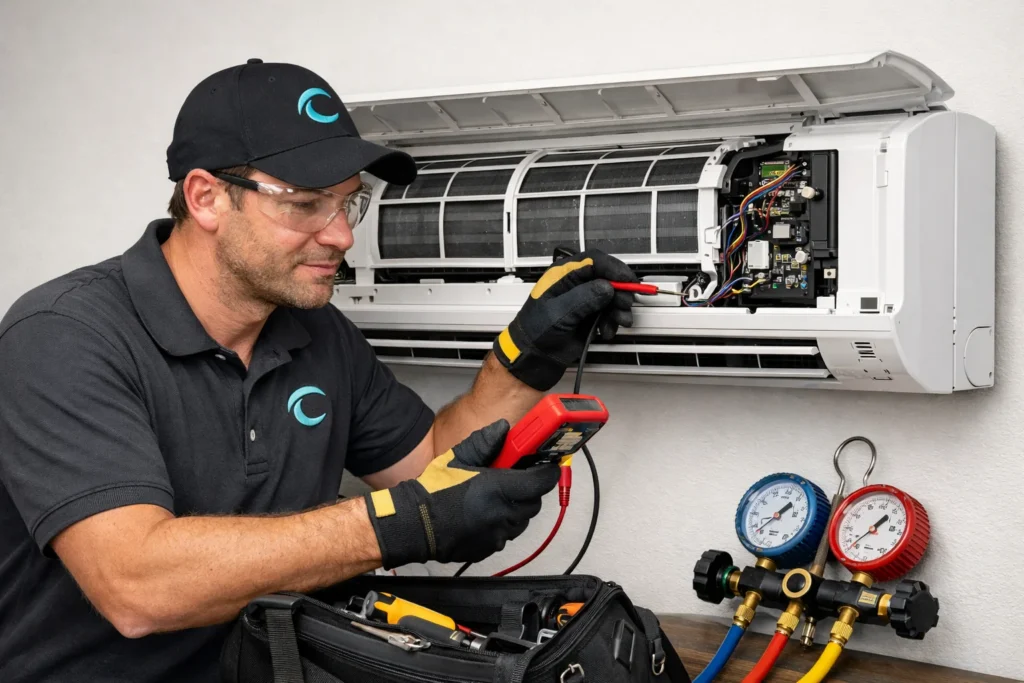
Why Professional Evaluation Matters
Online advice can show some possible direction, but no two HVAC systems are alike.
A professional inspection evaluates:
- System age
- Efficiency
- Repair history
- Current operating condition
- Remaining useful life
- Overall cost comparison
This gives a much more precise estimation than age alone.
Instead of a guess, homeowners can choose based on real performance and anticipated costs from the systems.
Conclusion
If you’re asking, should i repair or replace my ac unit, the answer depends on your system’s age, repair history, efficiency, and overall condition. Minor repairs on younger systems are often worthwhile. Older units with frequent breakdowns, rising energy bills, and major component failures usually make stronger candidates for replacement.
The Air Mavericks team assists Largo homeowners in assessing both choices with integrity and expertise. From simple repairs to full system replacements, you can expect upfront pricing, trustworthy advice, and top-notch workmanship from our experienced technicians. Air Mavericks is a family-owned and operated HVAC company dedicated to helping homeowners relax in climatized comfort while making the right choices about their air conditioning system.
Need help deciding whether to repair or replace your AC? Contact Air Mavericks today for a professional HVAC evaluation and get expert recommendations tailored to your home’s needs.
Frequently Asked Questions
Q: How do I know if my AC is worth repairing?
A: Generally, if the unit is under 10 years old and the repair is relatively affordable, repairing is often worthwhile.
Q: At what age should an AC unit be replaced?
A: Most air conditioners should be evaluated for replacement around 12 to 15 years of age, depending on maintenance history and performance.
Q: Is it cheaper to repair or replace an AC unit?
A: Small repairs are usually cheaper. However, repeated repairs and poor efficiency can make replacement more cost-effective over time.
Q: What is the most expensive AC repair?
A: Compressor replacement is typically among the most expensive repairs and often leads homeowners to consider replacement.
Q: Can a new AC lower my electric bill?
A: Yes. Modern high-efficiency systems often consume less energy and can reduce cooling costs, especially in Florida’s climate.